

Upcoming Events

Celebration of the Feast of St. Josaphat
November 12, 2026
Basilica of St. Josaphat
Divine Liturgy 6 PM
Reception to follow in the Undercroft
Join us for a special celebration honoring Saint Josaphat, Bishop and Martyr, on his feast day, Thursday, Nov 12, at 6 PM. His courageous commitment to Christ and his tireless work for Christian unity continue to inspire the Church today. The celebration will feature a Divine Liturgy presided over by Bishop Venedykt Aleksiychuk of the Ukrainian Catholic Eparchy of Saint Nicholas of Chicago, with Bishop Robert Pipta of the Byzantine Catholic Eparchy of Parma serving as homilist.
Come pray with us as we celebrate St. Josaphat and give thanks for 125 years of faith and worship in our beloved Basilica.
Co-sponsored by the Basilica of St. Josaphat and the Sheptytsky Institute
Wethersfield Institute 2026-27
Stillman Lecture Series
(series overview below)
Lecture Four:
The Armenian Badarak: The Divine Liturgy of the First Christian Nation
"O mystery deep, inscrutable, without beginning..."
Armenian Divine Liturgy, hymn of the vesting
Speaker: Fr. Haig Chahinian
Armenia was the first nation to embrace Christianity, and for sixteen centuries its people have offered the Divine Liturgy, the Badarak, in their own language. Rooted in the ancient worship of Jerusalem, Syria and Cappadocia, the Armenian tradition stands between East and West: unleavened bread offered with an Eastern anaphora, and a sanctuary veiled by a curtain rather than an icon screen. This lecture walks through the church, the vestments, the chant and the rite itself, and shows how the Armenian Church has kept its faith by praying it, through empire, exile and genocide, in full communion with Rome.
January 28, 2027
Basilica of St. Josaphat
Vespers: 6pm
Lecture: 6:30pm
Refreshments and Q&A
to follow in the Undercroft
Lecture Five:
Diversity and Identity in the West Syriac Liturgical Tradition
Speaker: Fr. Michael Shami
What do we mean when we speak of “the” West Syriac Eucharistic tradition? The West Syriac tradition preserves a remarkable diversity of Eucharistic prayers, hymnody, ritual practices, and theological expression. The West Syriac tradition contains roughly eighty anaphoras (or Eucharistic prayers), the range of which differs substantially in structure, theology, and even their institution narratives. Alongside these Eucharistic prayers stands an extraordinarily rich hymnographic tradition that has given successive generations of Syriac Christians distinctive ways of contemplating and celebrating the mysteries of Christ.
This lecture will explore the West Syriac Eucharist as a tradition characterized not by liturgical uniformity but by creative continuity. It will consider the diversity of its anaphoras and hymnody and ask how such variety can coexist with a recognizable liturgical identity. Within this question of diversity and identity, particularly for communities that have existed in sustained contact with the dominant Latin West tradition, it is opportune to ask what does it mean for an Eastern Church to receive the universal Catholic faith without reducing its own liturgical inheritance to a variation of the Roman Rite?
June 3, 2027
Basilica of St. Josaphat
Vespers: 6pm
Lecture: 6:30pm
Refreshments and Q&A
to follow in the Undercroft
Lecture Six:
Latin Rite
Speaker: Fr. Michael Uwe Lang
September 21, 2027
More information to come!
Basilica of St. Josaphat
Vespers: 6pm
Lecture: 6:30pm
Refreshments and Q&A
to follow in the Undercroft
Wethersfield Institute 2026-27
Stillman Lecture Series
Overview
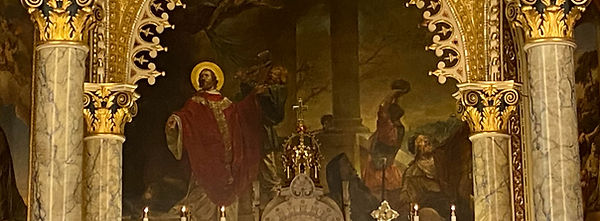
According to the Creed, the Church is “one” and “catholic,” meaning universal. This universality is witnessed through the diversity of apostolic worship across the 24 Catholic churches that comprise the Catholic communion of churches. Of these, 23 are of Eastern rite. In the places around the world that are hurting most — the Holy Land and the Middle East, Ukraine, Ethiopia and Eritrea, to name a few — we find these Eastern Catholic churches on the frontlines, witnessing to the Body of Christ in faith and works. This lecture series will present the rich diversity of worship in the universal Church, including in the Byzantine, Alexandrian, Syriac, Armenian, and Chaldean rites of the East, and the Latin rite of the West. Learn about the Eucharistic liturgies of these various traditions that preserve, promote and proclaim the unity and catholicity of the faith.
Past Events
Wethersfield Institute 2026-27 Stillman Lecture Series
Lecture Three:
The Theology of the Byzantine Tradition as Experienced in Liturgical Worship
“We venerate Your Passion, O Christ...
show us also Your glorious Resurrection.”
(Byzantine Rite hymn of Good Friday)
Speaker: Rev. Dr. Daniel Galadza
The venerable patrimony of Byzantine Rite Catholics is well known in America, mostly for its emphasis on beauty and the “smells and bells” of liturgical worship. This lecture will delve deeper into the beauty of the depths of the Byzantine theological, liturgical, spiritual, and ascetical tradition, as presented in its Divine Liturgies, the Liturgy of the Hours, and throughout the celebrations of the liturgical year, in its contemporary Greek and Slavic expressions, going back to its roots in Jerusalem and Constantinople.
Lecture Two:
The East Syriac Eucharistic Tradition: Theology, History, and Identity in the Chaldean Catholic Church
"When we receive the holy body and blood of our Lord, we receive life and are renewed. The hidden fire of divinity comes to dwell in us and purifies us from all stain of sin." -John of Dalyatha
Speaker: Fr. Marcus Shammami
The East Syriac liturgical tradition constitutes one of the most ancient and theologically rich Eucharistic traditions of Christianity. Preserved within the Chaldean Catholic Church, it emerges from the Aramaic and Semitic Christian world of Mesopotamia and reflects a sacramental theology deeply marked by biblical typology, symbolic realism, and ecclesial consciousness. This lecture offers a historical and theological examination of the East Syriac liturgy, focusing especially on the Anaphora of Addai and Mari as a foundational witness to early Eucharistic faith and practice. By analyzing the liturgy’s historical development and theological structure this lecture argues that the East Syriac tradition is best understood not simply as an inherited ritual form, but as a living theological tradition in which worship serves as a primary vehicle of doctrinal memory, ecclesial identity, and sacramental participation in the mystery of Christ.
Lecture One:
The Alexandrian Tradition Within the Liturgical Diversity of the Catholic Church
Speaker: Subdeacon Brian A. Butcher, PhD
“In that day there will be an altar to the Lord in the midst of the land of Egypt, and a pillar to the Lord at its border.” (Isaiah 19:19)
The venerable patrimony of Coptic- and Ge’ez-Rite Catholics, though less known in America than that of other Easterners, has much to teach us in regard to inculturation, as well as ecclesial unity-in-diversity. This lecture will introduce the variety of Oriental traditions cherished within the Church today, before focusing in on the Christian heritage of Alexandria, in its contemporary Egyptian and Ethiopian/Eritrean expressions.
Wethersfield Institute Salon & Panel Discussion on the Ecumenical Councils of the Catholic Church
Thursday, January 29, 2026, 6:45 PM
Italian Community Center - Milwaukee, 631 E Chicago St, Milwaukee, WI 53202, USA

6:45 PM: Reception with Wine, Cheese, and Refreshments
7:15 PM: Panel Discussion with Matthew Levering and the Four Stillman Lecturers, Public Q&A to follow
AD 2025 marked the 1700th anniversary of Nicaea, the Catholic Church's first Ecumenical Council, and the 60th anniversary of the closing of Vatican II, her most recent. In commemoration of these milestones, the Wethersfield Institute hosted four lectures at the Basilica of St. Josaphat each focusing on a subsequent 500 year epoch of councils. The Institute is bringing these speakers back to Milwaukee to help understand the whole breadth of the Councils in one evening.
Speakers:
Stillman Lecture Series at the Basilica
2025 Stillman Lecture Four
Rupture or Reform?: From Trent to Vatican II
Speaker: Dr. Eric DeMeuse
Thursday, November 20, 2025
Watch the recorded lecture here
The relationship between “Tridentine/traditional” versus “Vatican II” Catholicism has grown increasingly fraught in the last decade. Dr. Eric DeMeuse’s lecture will explore the historical roots of this tension from Trent to Vatican II and examine:
- What does the authority of the Church entail?
- How should the Church worship in her liturgy?
- How should the Church relate to the modern state?


2025 Stillman Lecture Three
Councils for Christendom and Beyond: Governing Perfection in the Central Middle Ages
Speaker: Donald Prudlo
Thursday, September 11, 2025
Watch the recorded lecture here
The Councils of the Medieval period (1000-1500) represent the Church maturing in her self-understanding while refining her relationships to the broader world. This lecture will be a thematic (rather than a specifically chronological) examination of four key areas: ecclesiastical reform, the constitution of the Church, the healing of the rift between eastern and western Christianity, and the struggle against medieval heresies. It was the councils of this period that outlined the Church that we know today in her institutions, practices, and offices; to know them is to know who we are as Catholics better.
2025 Stillman Lecture Two
Hymning the Icon of the Invisible God: How the Later Christological Councils Show Us the Christ
Speaker: Fr, Andrew Summerson
Thursday, June 12, 2025
Watch the recorded lecture here
“Who do you say that I am?” Jesus asks a heavy question. To get this question wrong, risks getting Christianity itself wrong. In the second half of the first millennium, this query from the gospel still echoed. Christians labored over the right responses to Jesus’s words in their theology, prayer, and preaching to draw others more deeply into the mystery of Christ. In this lecture, Fr. Andrew will give an overview of the councils, contexts, and figures that shaped this language and how we are to look upon Christ—God’s human face—and praise him with the words and traditions formed in this period from Chalcedon to Nicaea II.


2025 Stillman Lecture One
Why Sunday's Creed is More Than Words: Orthodoxy, the Integrity of Christian Identity, and the Earliest Ecumenical Councils
Speaker: Dr. James Papandrea
Thursday, March 20, 2025
Watch the recorded lecture here
Join Dr. Jim Papandrea as he leads us through the drama of the first four Ecumenical Councils (325-451 A.D.) that fought over and answered the fundamental, life-shaping questions:
-
Who — and what — is Jesus Christ?
-
Who — and what — is God, the Trinity?
-
What is Christianity?
-
What is a Christian?

2024 Stillman Lecture Three:
Liturgical Prayer: Let Us Go into God’s Presence Singing for Joy
Speaker: Fr. Brad Krawczyk
Thursday, November 21st
Vespers: 6:00pm (optional)
Talk: 6:30pm
Refreshments and Q&A to follow in the Undercroft
2024 Stillman Lecture Two:
Raising the Mind and Heart to God: Prayer in the Catholic Tradition
Speaker: Bishop James T. Schuerman
Tuesday, September 17th
Vespers: 6:00pm (optional)
Talk: 6:30pm
Refreshments and Q&A to follow in the Undercroft

2024 Stillman Lecture One:
20 Centuries in 20 Objects: The History of the Church through the Art and Architecture of the Basilica of St. Josaphat

Speaker: Dr. Paul Monson
Wednesday, June 5th
Vespers: 6:00pm (optional)
Talk: 6:30pm
Refreshments and Q&A to follow in the Undercroft
The Church and the Land: A Practical Symposium
Wethersfield Institute is honored to co-sponsor this annual event at the Catholic Ecology Center with the St. Irenaeus Institute for Catholic Thought and the CEC.
Celebrate the Feast of St. Francis of Assisi at the CEC in a family-friendly setting as we consider how cultivating the earth through gardening and homesteading enriches the life of Catholic faith All ages and experiences are welcome!

Where: Catholic Ecology Center - W1468 County Road NN Neosho, WI 53059
First Annual: Saturday, October 5th, 2024
Second Annual: Saturday, September 27th, 2025
Third Annual: Saturday, October 3rd, 2026
Previous Speakers:
Shawn and Beth Dougherty
Jason Craig
Rooted: Cultivating a Green Philosophy
The Wethersfield Institute is honored to partner with The Roger Scruton Legacy Foundation in hosting a series of virtual interviews led by Grace Olmstead. Throughout the series, Grace and her guests will cover a wide variety of topics that relate back to Scruton's love of home - what he referred to as Oikophilia.



"What is a Church? Exploring the typological and historical roots of Church architecture."
Annual Architecture Lecture at Sacred Heart Seminary and the School of Theology in Franklin, WI
December 4, 2026
December 5, 2024
December 7, 2023
